Friday, December 12, 2014

Dafen


Dafen (Chinese: 大芬; pinyin: Dàfēn) is a suburb of Shenzhen. In the early 1990s a group of about twenty artists took up residence in this town. They specialised in the making of large numbers of replicas of oil paintings by masters such as Van Gogh, Dalí, da Vinci or Rembrandt and more.
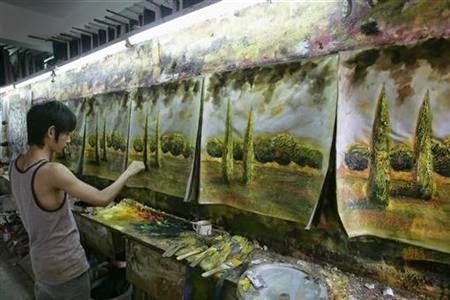
Most paintings we see in western hotels come from Dafen. It is common for these village painters 
to receive an order for 5000 of a particular artwork for a hotel chain in Dubai for example.
Many are trained at art academies in the required techniques and produce dozens of replicas daily.
Most of the artists reside elsewhere but spend a portion of the week living and working in the tiny alley spaces.
Today, the village sells both originals and replicas at very reasonable prices. One of my colleagues at the
residency ordered two different Mondrians and another a Mona Lisa to bring home as gifts.

I'm not sure how I feel about it. It seems like too much of a caricature of how China is viewed in the world – as a copier. We place high values on innovation and originality so it's difficult to understand how a culture that seeded civilization with game-changing inventions like paper and language, could seem to be so plagiaristic. But in the end it's a business that requires both skill and discipline.
Cultural questions to research and think about, but one thing is for certain, and that is when the Chinese organize themselves, they do it methodically and in a big way. There is a respect for detail within these systems that you don't necessarily see in other parts of their everyday life, more about that later.
I also feel like there's potential for a crazy interactive installation. Like a Hall of Mirrors sort of thing where you would have a painting copied, then have the copy painted, ad infinitum and watch to see if any aberrations emerge into new compositional elements over time.  
One of the art stores I frequented often.
Wonderful and affordable papers and brushes in all shapes, materials and sizes.

The real purpose of this trip into Shenzhen was to pick up some supplies. My plan for this residency was that I didn't have a plan. Traveling so far and to China, the source of all things manufactured, I thought that it was most efficient to purchase my materials when I arrived and save all that shipping back and forth. Seemed like a sound approach but I soon learned how time consuming it is to navigate Shenzhen and with only a month at Da Wang, I was beginning to panic that I wouldn't have enough. I came with an interest in China's folk customs and craft that I wanted to explore, but didn't yet know what media I would be working in, so I did my best to anticipate some basic tools and hoped that inspiration would hit once I got to the studio.
I met a master craftsman carving traditional stone stamps. A friend of Tom's who works in Dafen.
I became so enamored by his talent and the compelling antique Chinese pictographs that I ordered several stamps
to bring home. Thanks to Tom's help with the language and translation,
we were able to have a few meaningful words and concepts hand carved into beautiful stones.

One my stamps in original pictograph Chinese language.
Translation: 'By Hand' or 'Handmade'.


This post is part of a series documenting my experiences in China. 
Please follow previous entries by using the blog archive in the sidebar to the right. Or click here for the beginning. 

Wednesday, December 10, 2014

Arrival

After flying from Boston to NYC to Beijing, there was a final 3.5 hour flight to Shenzhen. The Shenzhen Airport opened a new terminal last year. It is another architectural marvel with inventive materials, ephemeral use of light and a very funky design. After being jettisoned halfway around the world, it felt very space-like and surreal. 

Da Wang Culture Highland, an hour from the airport and on the southern fringe of Shenzhen, is situated at the end of a sparsely lit remote backroad that passes by two fresh water springs, an outdoor athletic facility with bike rentals and a couple of restaurants. It's not well known to anyone who hasn't been there and most Shenzhen taxi drivers, including mine, have not been there. Add to the mix that neither of us could communicate with each other. Lots of extraneous hand signals and smiles later, his determination paid off and we found our way. With his persistence, and making many stops for directions, he found the very dark entry to the very dark road that would eventually lead us to the residency.

It was a bit unnerving to be left alone in the back seat while the taxi driver repeatedly ventured out to ask for help from local people. Since I had just arrived, I was still imbibed with my city-girl instinct to approach every situation with trepidation. I fought the impulse to lock all the doors. Over the next week, however, after experiencing how peaceful,
kind and safe China and its people are, I quickly set myself at ease.
The entrance, in daylight, to the long road that leads to the residency.
We drove by it several times before we realized where we were going.  

The road is lined with a tree that is native to the area called Rong Shu. They grow to be very advanced in age with branches that sprout offshoots that fall to root in the soil. Each shoot adds a concentric layer to the growing trunk so that mature trees grow very thick with many fibery layers. Driving in the dark, the headlights would illuminate these viney fibers that hung from the branches into the road and it felt very magical.


My very first impression was how dark it was. I felt this often when in China. Unless you were in a main city square, where they have large neon signs constantly flashing like in Times Square, the exteriors and interiors of China are very dimly lit if lit at all. Most rooms have one fluorescent light in the ceiling for illumination and most streets only have a single post or light for every block. Being energy conscious, it makes sense to use fluorescent light but it isn't very attractive or conducive to coziness.

One night when walking the road back from the village.
A section of the path just before the entrance to Da Wang.
Red lanterns hanging from a tree.

My taxi finally pulled up at 11:30 pm and I was met by Tom Hayes, the art director of Da Wang, who led me to my room and helped me settle in. So I literally wasn't able to see where I had landed until the next morning when I woke up. It was like opening a present to see the surprise.

The first floor housed staff and some permanent residents. The second floor is where most of the artist residents lived.


Like most residencies, the accommodations are sparse but clean and just what you need. It didn't take long to fall into a routine with my morning Nescafe, yogurt and fruit while sitting at my desk listening to the rhythmic sweeping of the workmen in the circle and the birds chirping in the trees.  

I was lucky to have my own water cooler. A privilege to be able to make my
instant coffee while still in pjs - just like home.

A roommate living on my balcony. Easily 5 inches long. Being in a tropical zone the critters are very exotic.
It's creepy enough to have these large species around, but even worse that they also have special powers.
This spider can jump, the 3 inch cockroaches can fly and the snakes are poisonous. 

I left Boston the morning of October 29, arrived at Da Wang at 11:30 pm October 30. My first day there was October 31 and my first stop that morning was to go to reception and sign in. I was met by Shiny who congratulated me on my holiday, the American Festival of Halloween. To celebrate we were to go out that night to discos in Shenzhen and Ayi the cook was making her special noodles for the occasion too.


This post is part of a series documenting my experiences in China. 
Please follow previous entries by using the blog archive in the sidebar to the right. Or click here for the beginning.  

Tuesday, December 9, 2014

China

On my way out of Logan and flying to JFK for connecting flight to Beijing.
Then a domestic flight from Beijing to Shenzhen. In total, a 30 hour trip from door to door
with a 12-hour time difference.

I just returned from a 5 1/2 week stay in China. The first month I was a resident at Da Wang Culture Highland with 4 other artists from Holland, Great Britain and China. The last 10 days I travelled to the north visiting Xi'an and Beijing with my husband.

I tried to journal as much as possible but kept it brief so as not to become totally burdened and bored with the task. There was very limited internet due both to the censorship of the Chinese government and the poor access that comes with being located at the base of a Mountain in a rural area. So this means that I'm trying to write about my first impressions, 6 weeks after the fact, and now at home on the other side of the globe in Boston. I hope I can capture the awe of what is was like for me.

China is indescribable. Everything is different. The language is impossible to decipher both the spoken and the written. Hand signals mean different things, even counting from 1 to 10 uses different gestures than we know. Communication is non verbal if at all. For someone whose work often involves public interaction and participation, it's a very strange way to inhabit a space.

Da Wang Culture Highland is a rural area officially cited as an arts center and shares its space with an experimental Waldorf School and several small restaurants. It's very chinese to integrate all categories of living situations together – in this case a nature conservancy plus arts center plus several restaurants plus school, plus bike path etc etc. At first I had a tough time getting my head around it, but quickly learned to just accept this new type of organization for what it was, instead of trying to reformat it into my alien western template. This became a recurring theme for my stay here, to ignore my preconceptions and be accepting of different realities.

The legendary squat toilets that everyone likes to talk about. Not so bad and really quite practical. As for toilet paper... everyone just brings their own. And if we're totally honest about it, even though it's expected to be provided, most American public toilets don't have it either. I spied many young Chinese women brandishing large packages in their very stylish and quite trendy pocketbooks.

Da Wang is located just outside of Shenzhen, a monster of a city that in the early 1980s was proclaimed to be a number one Special Economic Zone. This means that they receive priority for financial and infrastructure support from the government as a center for manufacturing and production. In a short thirty years it has grown from a very small fishing village to a behemoth city of 40 million people. I was told that it takes about 3 hours to travel from one end to the other by car.

A major road before rush hour. As one would expect in such a densely populated area, the traffic here is legendary. I even heard about 'People Jams' where individuals get stuck in a crowd while walking down the street and it sometimes can take 10 minutes or more to become clear of it.

The growth is ongoing. The web of businesses and apartment buildings is incomprehensible. The population is mostly young people transported from small villages from the middle of China. One of the first questions between native Chinese in Shenzhen is to ask each other which province they come from, because no one is from Shenzhen. Instead of an organic emergence from the roots up, it is fabricated from a predetermined plan of expansion and productivity imposed from the top down.

Shenzhen is all about the shopping mall – I only visited one here at Coco Park but saw many listed on the Metro map all over the city. Being so young, the architecture is very new and contemporary. The contrast was exaggerated even more with my return to the States - ours is very dated in comparison. They invite the best and brightest architects from all over the world to design here. It's very exciting to see.

There is an air of optimism, hope and possibility. They have a new and unprecedented consumer presence and there is no scarcity of jobs for the young like in most western cities. It definitely feels like a new frontier. That said, there is a sense of emptiness, confusion and wonder about their new identity. Building concrete infrastructure is a simpler task than the development of a city's culture and soul. China's rich history dates over 8000 years and Shenzhen is happening in about 30, creating a gap where a young and diverse population is patiently trying to find their place within the rapid expansion of bricks and mortar.

This shot was quickly taken from inside a taxi. It is what the Chinese call a Ghost City. In the whole of China there are over 60 million empty apartment skyscraper buildings. Since the country doesn't allow foreign investment, the wealthy middle class invest in the national construction projects. Historically the booming real estate market has made this a profitable investment with good returns. With this current glut of buildings, some are predicting a financial collapse. Others think the government is planning on using them to house more people that they move from the country villages.

The following posts are a collection of singular, random events that hopefully will translate into what it was like to face the challenges of daily life in such a strange land yet still be able to focus on artwork. I arrived at Da Wang without a plan and without many materials to speak of. This sounded so romantic at the time but I quickly realized that this decision was going to push me into directions where I needed to be flexible and resourceful with whatever materials I could find within my immediate surroundings.

With two suitcases, only two hands and traveling alone, my carryon needed to be a backpack. It was tricky to figure out what to bring for 3 different weather latitudes, art supplies, gifts, and electronics for over a month. 


This post is part of a series documenting my experiences in China. 
Please follow by using the index in the sidebar to the right. 


Monday, September 8, 2014

New Work


MIRROR MIRROR

Aluminum foil tape wrapped around certain tree trunks and branches on the bank of the pond. The effect transforms the natural bark to a shiny seductive surface, catching the eye as one turns the bend in the path. It's an unexpected, flashy and lyrical menagerie.

The artificial silver reflects the nearby foliage resulting in a manufactured green projecting back onto the trees. Some of the trunks are left natural with bark and lichen growth in tact, creating a setting where two types of beauty coexist in rival with each other. The metal suggests artificiality but with closer inspection you see that there are live leaves sprouting from the tips of the branches, playing with perception, material and meaning.


TOUCHED

If you continue on the path from Mirror Mirror around the bend and take a left up a hill, you'll approach another work in this series. This one is a found tree trunk wrapped with a metallic gold mylar tape.


Instead of live trees that are marked for removal, this is a fallen log found as is and positioned in the split of another tree. A surprisingly aggressive gesture. 

The metallic gold reflects and shines a light through the clearing to the meadow below, looking ostentatious, like a figure of conspicuous consumption.


These are experimental studies and were made possible by the generosity of Linda Hoffman of Old Frog Pond Farm & Studio. Linda is a sculptor and farmer. She has a studio on her farm where she creates beautiful sculptures out of tree trunks, wax and bronze. She grows organic apples, vegetables and raspberries and hosts a Sculpture Walk each year with a rich array of programming. 

I plan to be at the reception and look forward to meeting the 20 other artists and touring their work.

Harvard MA
Weekends September 6-October 5
Reception September 21, 1-5pm
Click here to view the eclectic events scheduled for this show.

Monday, September 1, 2014

Blog Hop!

I was invited by my NE Wax colleague Debra Claffey, to join in on this blog hop. The project consists of answering some questions regarding art and my art process as well as to highlight three artists/creatives that I admire.  First are my answers to the questions asked of me for the blog hop project:


1.) What am I working on/writing?
Having started a new job at Concord Art Association in late May, it's been challenging to create any artwork. However, the break  from the studio has enabled me to refine my concepts and explore new thoughts. One direction is the cross section of the science behind food culture and nature. Combining the themes of connection, society and the tricks of perception, similar to my earlier work, with of the politics of agribusiness and its effects on humanity.  How detached we become by outsourcing our every need, creating an obliviousness to the effects of our consumption, and an absolution of responsibility. I have two new and experimental installations (opening in September) that play with these perceptions and will be blogging about them soon.
2.) How does my work/writing differ from others of its genre?
It is difficult for me to define my work within any one genre. I am extremely process-oriented and materials-based with objects ranging from 6 foot charcoal drawings, to felted orbs, to wax interactive installations and lots more in between. Common themes are connection, tradition, science and design. 
3.) Why do I do what I do?
It is the best way for me to articulate for myself and others what I have to say and how I see the world.
4.) How does my writing/working process work?
Objects and materials spark my curiosity. It's usually a mystery why something catches my attention but I've learned to trust my instincts and follow the muse. Playing, watching and responding are the steps I go through with a methodical process that allows me to step outside myself and learn what it is I'm really thinking about.
And here are two artists that I admire (still working on a third... it's Labor Day Weekend and everyone is scarce!)
Martha Wakefield is a colleague of mine from an Artists' Coaching Group that we belong to. Martha's painting is gestural and vibrant like a breath of fresh air. 

Martha Wakefield is represented by Hope Gallery of Bristol, RI; Rocky Neck Gallery of Gloucester, MA; and Now Design Studios of Action, MA. She is the guest artist this month at the Barb Jackson Gallery in Rockport, ME. Her paintings have been featured in Wild Apples: A Journal of Nature, Art and Inquiry; on the book cover of Shadow and Light, A Litterary Anthology on Memory; and The Palette Magazine. She is a signature member of the International Society of Acrylic Painters, TheRhode Island Watercolor Society and is a juried member of the Cambridge Art Association of Massachusetts. A staff writer for The Palette Magazine she writes about technique and professional artists. She also teaches art workshops in the metro-Boston area. Wakefield's paintings have won many awards and are in private and corporate collections in United States and Canada.
Anne and I also met in the Artists' Coaching Group and she now resides and works in London, England. I've always admired Anne's aesthetic, craftsmanship  academic approach to her art making. I hope to keep this connection and maybe even visit her in London!

AnneKrinsky is a London-based painter and printmaker who also makes site-specific installations. She has received an Arts Council England Grant for the Arts for her project From Absorb to Zoom: An Alphabet of Actions in the Women’s Art Library, which will result in a site-specific print installation at Goldsmiths College in 2015. She previously has created installations about books and archived materials for library, museum and university settings in New England.  
Krinsky was funded by the Artist’s International Development Fund to research traditional textiles in India in 2014, traveling to Jaipur for block printing workshops and to Delhi for a residency at the Sanskriti Foundation. She also has been awarded residencies at Rocky Neck Artists Colony, Gloucester, Massachusetts; Fundacion Valparaiso, Mojacar, Spain; Brisons Veor, St. Just, England; Virginia Center for the Creative Arts, Amherst, VA; Vermont Studio Center, Johnson, Vermont and Millay Colony for the Arts, Austerlitz, NY. Her solo shows include Anne Krinsky: Reconfigurations at The Art Complex Museum in Duxbury, Massachusetts (2013) and the ten-year retrospective,  Anne Krinsky: Time/Line, 2000-2010 at the Trustman Gallery at Simmons College in Boston (2010). The British Museum, the Boston Public Library, the American collector Graham Gund and the U.K. charity, Paintings in Hospitals have purchased her works, as have numerous corporate collections in Europe and the US.
India Project Blog
Women's art Library project blog

Tuesday, July 22, 2014

Like Bees to Honey


POLLINATION   < >   / /   insemination–dissemination

The Lure of the Pod.

Reach inside the belly of a FLORA and pluck a seed of inquiry.

Each candy contains a question you need to unwrap, read and think about – hatching conversation, dialogue and debate between friends and strangers that lingers for more than the usual 30 second WIKI search.

These candies, like seeds, act as disseminators and makers of connections.


My latest interactive, Pollination/ The Lure of the Pod, was installed for one day during the ARTBEAT festival this past weekend in Davis Square and sponsored by Somerville Arts Council. Morbidly large organic flora hugged the tree and suspended two orchid-like creatures, each with large sacks hanging low with the weight of candy wrapped with questions. Questions designed to encourage dialogue and the dissemination of ideas on the street. It was very popular with over 450 candy 'seeds' sown throughout the day.


In my usual fashion... I outsourced this task with some generous friends over a potluck. Lets say we had some hysterically funny discussions of our own while reading and wrapping buckets full of Smarties.

 
To see other sculptural crochet, click here and here.
To see other interactives, click here.


Monday, July 21, 2014

EXPOSED in Stowe VT


This summer has been a whirlwind of activity with a new job as the Director of Education and Programs at Concord Art Association and several exhibition commitments that were promised in what seems like a millennium ago. So my time has been dedicated to the doing of it and not so much about the talking about it... Until today!

July 12 was the opening of Exposed an outdoor sculpture exhibition at the Helen Day Art Center in Stowe Vermont. The curators Samantha Cataldo, DJ Hellerman, and Amy Rahn selected a very interesting show with everything from 30 foot tall inflatables (Limppunklovejunk, Claire Ashley) to an inlaid braided rug out of ceramic tiles (Fictitious Force, Beka Goedde) and poetry revealed in a sequence of lawn signs along the recreation path (Meandering, Adria Arch).

I really am honored to be a part of this program this year with so many high quality entries. My installation RELIQUARY has evolved to include all my forgeries (Three assemblages: Stash I and II, Reliquary and 14 bronze balls of fiber). They're installed on a wide, low-hung branch that hangs over the width of the sidewalk on Main Street. 


These bronze sculptures are a trick in perception. Treated and painted to appear as if molded and cast in heavy bronze, they are in fact bundles of actual objects and very lightweight.   Their placement on a substantial but extended branch elicits a combined sense of curiosity and anxiety for those standing underneath. Curious how the branch is holding and anxious that the bronze may fall on top of them.


Bronzed sculptures installed in trees. Multiple assemblages tucked inside or wrapped around limbs, and attached to trunks. Each bundle contains items from the home - utensils, clothing, pillows, toiletries, toys, televisions and other artifacts of domestic life. Installing in a tree is symbolic of nests and shelters in nature.  Painted to appear as if cast in bronze to stand for a distinctive place and time and reinforce the notion that nothing is as it seems – much like the representations of material culture.


A special thanks to the Helen Day Art Center for organizing this very special show, especially the curator Rachel Moore and gallery manager Katharine Longfellow.